House Cricket (Acheta domesticus)
Identification
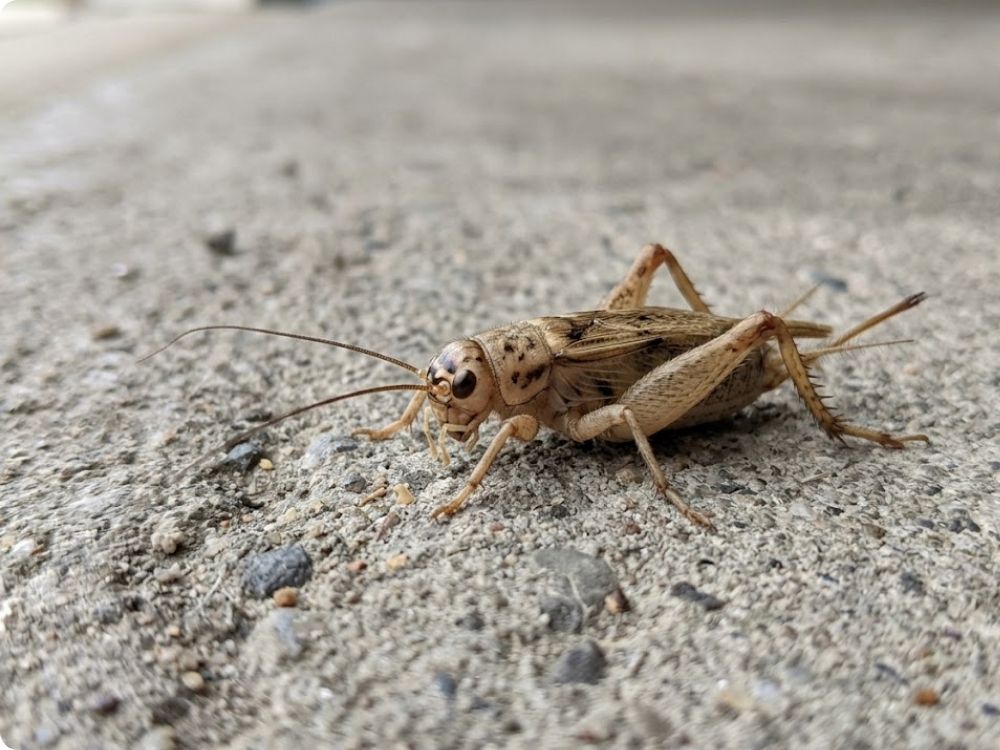
The house cricket is a light yellowish-brown insect, ¾–1 inch long, with three dark bands across the top of the head. Long, thin antennae extend beyond the body length. Hind legs are enlarged for jumping. Both sexes have wings that lie flat along the back, but only males chirp — they produce the characteristic sound by rubbing their forewings together (stridulation) to attract females.
House crickets are often confused with field crickets, which are darker (black to dark brown) and slightly larger. Both species enter structures, but house crickets are more likely to establish persistent indoor populations.
Why Crickets Invade Brownsville Buildings
Crickets are phototactic — they fly and jump toward light. Bright exterior lighting on commercial buildings, gas stations, and porch lights draws crickets from surrounding habitat to the building perimeter. Once clustered at the building, they find entry through gaps under doors, torn screens, weep holes, and garage door seals.
Brownsville's warm climate, shared with Harlingen and the rest of the Valley, stretches cricket activity from March through December. Brightly lit commercial corridors like East Price Road, Paredes Line Road, and Boca Chica Boulevard collect thick clusters of crickets on their walls at peak season. These mass aggregations at commercial buildings are the most common cricket complaint we receive.
Damage and Nuisance
Indoors, house crickets feed on fabrics (cotton, silk, wool, synthetics), paper, wallpaper, cardboard, and dried food. They can damage stored clothing, upholstery, and documents. Their droppings stain light-colored surfaces. But the primary complaint is the incessant nighttime chirping — a single male cricket inside a wall void or closet produces enough noise to disrupt sleep.
Dead cricket accumulations also attract secondary pests — carpet beetles, ants, and spiders feed on dead crickets, creating cascading pest issues from what started as a noise problem.
Reducing Cricket Pressure
Switch exterior lighting from white or mercury vapor bulbs to amber or warm-LED alternatives — this single change can reduce cricket attraction by 70–80%. Seal entry points at the foundation level: door sweeps, weep hole screens, garage door weather stripping. Professional perimeter treatment with residual granular bait kills crickets before they reach the building.
Think you have house crickets? Call us.
Call (831) 703-7142 — Mon–Sat 7AM–7PM. No forms, just a real local team.
Call (831) 703-7142