House Mouse (Mus musculus)
Identification
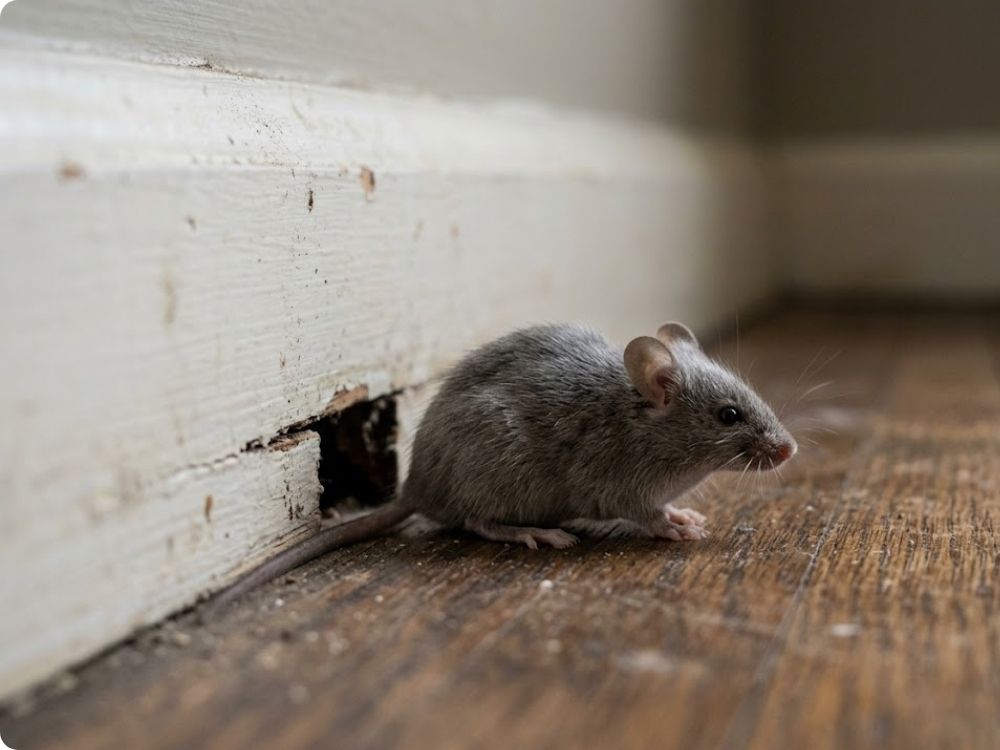
The house mouse is small — 2.5–3.75 inches (body) with a tail roughly equal to body length. Adults weigh just ½–1 ounce. Fur is light brown to gray with a slightly lighter belly (not the sharp contrast of a deer mouse). Ears are large relative to the head, round, and sparsely haired. Eyes are small and dark.
Mouse droppings are rod-shaped, about ¼ inch long, the size of a grain of rice, much smaller than Norway rat droppings, which are capsule-shaped and ¾ inch long. A single mouse produces 50–75 droppings per day, so even a small population leaves conspicuous evidence quickly.
Behavior in Brownsville Homes
House mice are the most adaptable rodent in the Valley. They live entirely indoors when conditions allow, nesting in wall voids, cabinet backs, appliance motor housings, stored boxes, and insulation. Even in newer subdivisions across Los Fresnos and Palm Valley, a mouse needs only a gap the width of a pencil, about a quarter inch, to get in. That is far smaller than most homeowners expect, which is why professional mouse control always pairs exclusion sealing with trapping.
In Brownsville, mice are active year-round with no seasonal die-off. A female house mouse can produce 5–10 litters per year with 5–6 pups each. One breeding pair can generate over 60 offspring in a year under favorable indoor conditions — and Brownsville's climate-controlled homes provide exactly those conditions.
Signs of Infestation
Rice-sized droppings in drawers, cabinets, pantries, and along wall edges. Gnaw marks on food packaging, plastic containers, and cardboard. Shredded paper, fabric, or insulation (nesting material). A distinctive musty odor in enclosed spaces. Small grease marks along baseboards where mice follow the same travel paths. Sounds of scratching or light scurrying in walls, particularly at night.
Health Risks
House mice contaminate 10 times more food than they eat through droppings, urine, and fur. They carry salmonellosis, lymphocytic choriomeningitis (LCMV), and hantavirus (though hantavirus is more associated with deer mice, house mice can carry it). Mouse allergens, proteins in urine, droppings, and dander, are a documented asthma trigger, particularly concerning in homes with children.
Think you have house mouses? Call us.
Call (831) 703-7142 — Mon–Sat 7AM–7PM. No forms, just a real local team.
Call (831) 703-7142