Roof Rat (Rattus rattus)
Identification
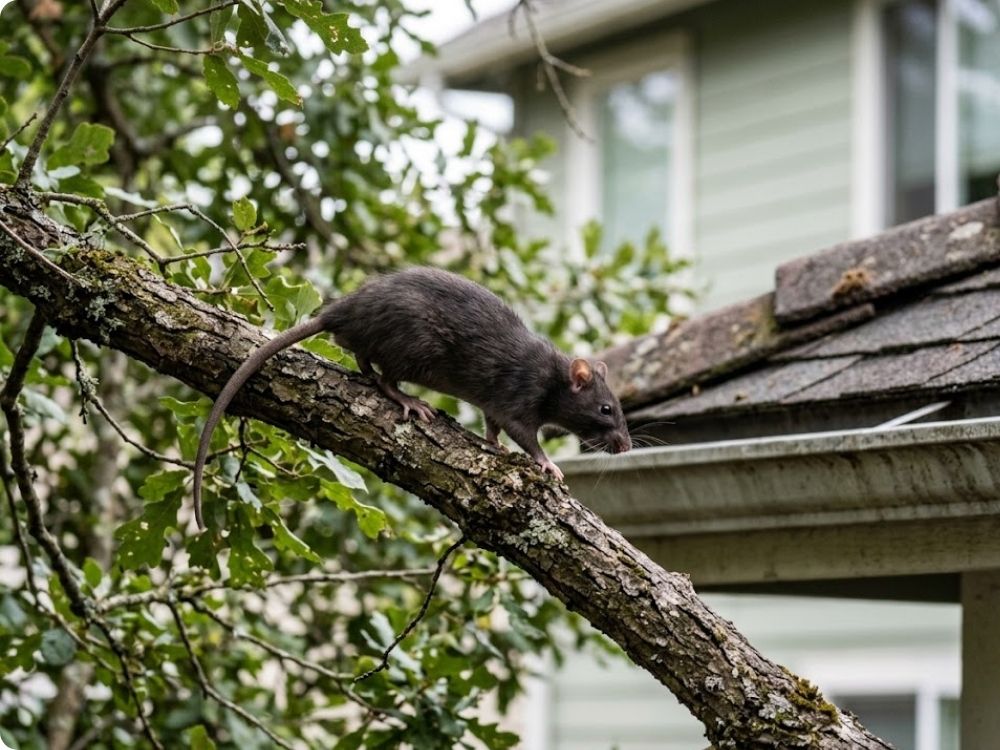
The roof rat is a sleek, agile rodent measuring 6–8 inches (body) with a tail longer than its body — a key distinction from the Norway rat. Adults weigh 5–9 ounces, lighter and leaner than Norways. Fur is smooth, dark brown to black on the back with a gray or white belly. Ears are large, thin, and hairless — when folded forward they reach or cover the eyes. The pointed nose is another distinguishing feature.
Roof rat droppings are spindle-shaped with pointed ends, about ½ inch long — smaller and more tapered than Norway rat droppings.
Behavior and Habitat in Brownsville
Roof rats are climbers. In Brownsville, they travel through the palm tree and live oak canopy, along fence tops, power lines, and overhanging branches to reach attics, soffits, and roof voids. They are the most common rat species found inside attic spaces in the Rio Grande Valley.
Brownsville's dense palm canopy gives roof rats an elevated highway, connecting trees to rooftops without their ever touching the ground. It is worst in older neighborhoods along Palm Boulevard, across Harlingen’s tree-lined streets, and through Southmost. Properties with palm trees within 6 feet of the roofline are at highest risk.
Signs of Infestation
Scratching, scurrying, or gnawing sounds in the attic or ceiling, especially at night. Spindle-shaped droppings in the attic, on top of insulation, or along roof-mounted utility lines. Gnaw marks on roof vents, soffit screens, and attic wiring. Fruit disappearing from citrus trees (roof rats are fruit feeders). Grease marks on downspouts, fence rails, and branch stubs where rats climb nightly.
Health Risks
Roof rats carry the same disease risks as Norway rats — leptospirosis, salmonellosis, and flea-borne murine typhus. In attics, they contaminate insulation with urine and droppings, degrading air quality when HVAC systems pull air through contaminated attic spaces. Gnawing on electrical wiring in attics has caused house fires in the Valley. Professional rat control addresses both the active population and the entry points they use to reach the attic.
Think you have roof rats? Call us.
Call (831) 703-7142 — Mon–Sat 7AM–7PM. No forms, just a real local team.
Call (831) 703-7142